Technical Sales Hiring: Generalist vs. Product Specialist
Recently, while working with a recruiting team to find a senior sales engineer, a topic that came up was: "What am I looking for?"
So — what am I looking for? For me, I'm looking for a solid foundation in technology. In this complex and complicated world, there are so many technical things to know. So you should decide early whether you need a generalist, or a specialist.
Generalist — someone who knows a lot of things to a great extent, but isn't the product specialist. They can design, present, and configure many products and solutions but would need the help of product management or a business unit to take the conversation very deep.
Product specialist — this is someone who spends a majority of their time with one (possibly two) products or solutions. As the term states, they are a specialist in the product/solution and know every aspect of it. To make an analogy, this is the "closer" (pitcher) on a baseball team that may come on the field with the game on the line.
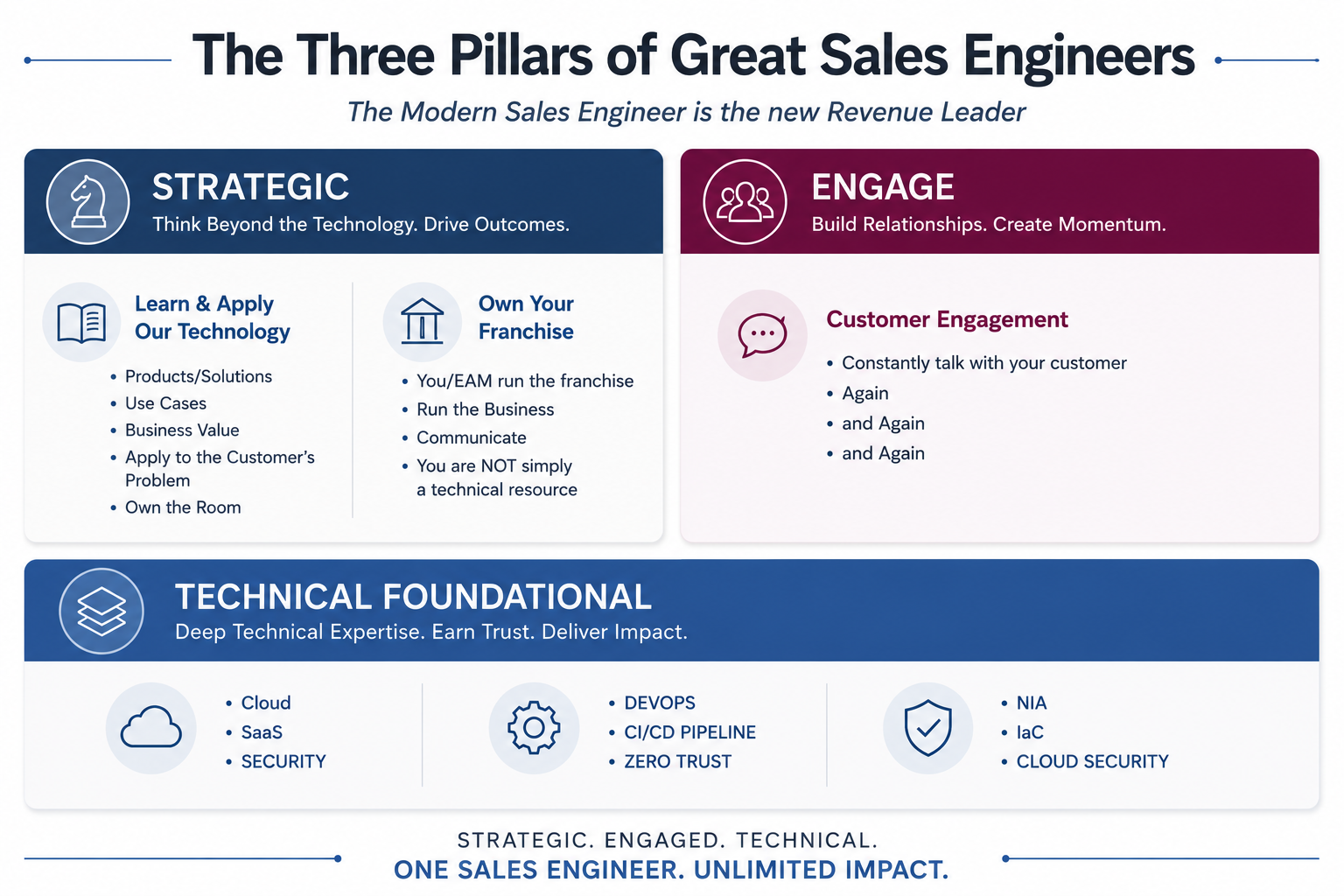
The 3 Pillars of Sales Engineering Vetting
A strong technical foundation
There must be a solid foundation on which to build. Technology moves fast, so this is extremely important. Does this candidate have experience in many aspects of building infrastructure or the cloud, for example? Do they understand security and cloud security? Do they understand application development and how apps are written and put into production? Questions like these are paramount in being the trusted advisor to your customers.
Strategic focus
This pillar sits atop the technical foundation and is divided into two sections: learning and applying your technology, and owning your franchise. You need to be able to know your products and solutions extremely well. Do you need that knowledge on day one? Absolutely not. And that's why a technical foundation is most important. Many of your candidates come from different backgrounds and have different experiences. Having a strong foundation allows them to learn new solutions, the business case and value, and the use cases where your products solve problems. What's also important is a personality that lends itself to "owning the room." Can your candidate lead a presentation, handle customer objections, and influence your buyer?
The second part of strategic focus is "owning your franchise." The Sales Engineer is not simply a passive tool in a toolbox brought in to fix a single technical problem — they are an active seller and business partner with the Account Manager. They both run the business.
💡 The Franchise Mindset
The Enterprise Account Manager and the Sales Engineer own a McDonald's franchise. It's their responsibility to cook the food, clean the tables, and greet their customers. Corporate finds the real estate and creates the process, but the franchisee runs the business.
If an SE candidate lacks this ownership mentality, they will kill your early-stage pipeline velocity. They will wait to be told what to do rather than driving the revenue strategy. To screen for this specific "franchise mindset" during your interviews, you need to look past technical checklists and deploy situational questions.
Engagement
People still buy from people. They also do not buy from people. The sole reason anyone will buy something is that it solves a material problem they have. That really is the only reason. No exceptions.
But there's more. When you interact with a prospect in any manner, if they do not clearly understand what problem you solve right away, they will remember nothing you say. Not your name, not your company name, not your awesome tech. That's because humans mentally organize information based on problems — not technology, or vendor, or the awards you've won.
Everyone in the company must align on the problem; sales, marketing, customer enablement, support, customer success, management — everyone.
Sales people and sales engineers, especially when prospecting (pipeline generation), are taught to ask a lot of questions — much of it focused on qualification. Prospects hate that (and yes, you must do it anyway). Traditional sales advisors will give your team a rigid qualification script or an abstract framework to read from. But in deep tech, reading from a checklist destroys credibility instantly. Your next great hire needs the business acumen to discover problems organically, not paint-by-numbers theory. Ask questions that validate that they have the problem and that they want that problem gone. Then you can focus on their budget, org, insertion, etc.
Marketing people try to create a sense of buzz around a company. That's great if you do it by harping on how horrible the problem you solve is, and express joy in helping customers through it. Anything else is about you. It's not personal, but the customer doesn't care about your process.
What you're looking for in a sales engineering candidate is the ability to do all that. We're not looking for an "implementer" or someone who can "code." We're looking for someone who understands technology and can impart the value of what someone can do with that technology. I like to say, "technology isn't an end in itself, it is a means to an end." Do they need to be a hands-on user of your technology? Although that would be a "nice to have," it certainly is not a requirement. They don't work for you (yet). Which brings us back to the technical foundation part — if the candidate has a solid one, there will not be a problem learning your technology and applying it correctly. You should be looking for great people. I don't care that their last job was two years ago and now they want to get back into the workforce.
Here's what I care about
- Desire to learn: You want to learn and you put in the effort to do it.
- Ego-free growth: Your personal growth is more important to you than your ego.
- Constructive feedback: You crave it, and are comfortable giving it.
- Contextual understanding: You understand the problems the company is trying to solve.
- You see the big picture: You understand the roles and challenges of other people on the team.
- Empathy for clients: You deeply care about our clients. And their customers.
- Team awareness: You deeply care about people, and our impact on their lives.
- Mission-driven fulfillment: You feel personally fulfilled by helping others succeed.
- Natural curiosity: You are curious about finding new ways to solve problems.
- Outcome-oriented: You thrive on goals and outcomes and can't just go through the motions.
- Natural authenticity: You're authentic, and don't have the DNA to "fake it."
14 Strategic Sales Engineer Interview Questions to Ask Candidates
In no particular order:
- Tell me about how you would go about finding the customer's problem. Some call this the discovery stage.
- What types of information are you trying to gather at this stage? Using a 13-week quarter, and a 26-week half, what percentage of time would you say should be spent in discovery? Should this be the longest stage of the sales cycle, or should something else (like the POC stage) be the longest stage?
- If a customer is looking for a feature or functionality that the company does not support, how would you go about getting that feature into our product?
- Tell me about an account (or two) where you are viewed as the "technical advisor." Which teams or people do you have direct accountability for?
- Your EAM (or SE director) is on PTO this week. What are you doing while they're out?
- Is part of your process in helping the customer understand the value of your solution a demo, workshop, or POC? When would you use each?
- Do you always go for a POC? Or should you try to avoid a POC at all costs?
- What is the purpose of the first meeting?
- What is the purpose of working with the practitioners at your customer?
- How do you get the introduction to their leadership, or the budget owner?
- Using an example of a company like Disney (or JP Morgan) — would you consider that one customer? If yes, why? If no, why not?
- When does the "second sale" begin?
- When you hear the term "post sales," what does that mean to you? Is that the same as the term "post sale"?
- How often do you talk with your EAM during the week?
As you can see from these examples, not one relates to "how do you configure a VPC in a public cloud?" We are in sales. Yes, if during the course of selling we're asked to answer a technical question, that's our job. But no one should be confused on what roles we play: we are in sales.
ADVICE: To evaluate these answers accurately, you can use a structured candidate scoring framework.
Lastly — is the person you're speaking with dynamic? Fun? Exciting?
Major rule: no jerks allowed (or add your own nouns and adjectives here).