
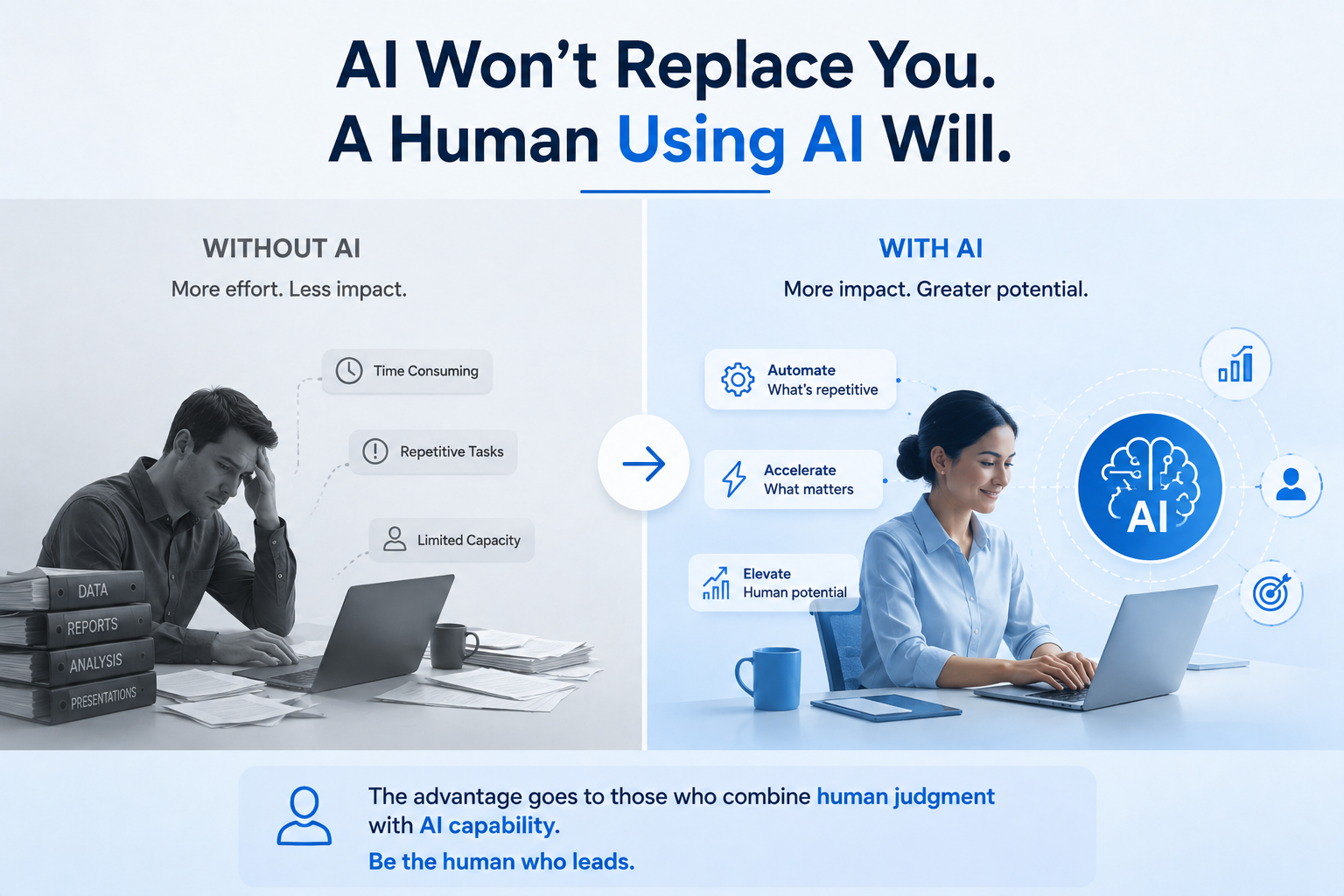
There's a sentence that gets repeated so often in boardrooms, LinkedIn posts, and panicked group chats that it's started to feel like a law of physics: AI is going to take your job.
It's the wrong sentence. Not because it's too alarming, but because it's imprecise in a way that leads people to prepare for the wrong future.
The more accurate version — the one that actually explains what's happening in workplaces right now — is this: AI won't replace you. A human using AI will.
That single word swapped in changes everything about how you should think about your career, your team, and the next five years.
The difference between a tool and a threat
Every major shift in how we work has followed the same pattern. The spreadsheet didn't replace the accountant; it replaced the accountant who insisted on doing everything by hand while a colleague ran circles around them with formulas. The word processor didn't replace the writer; it replaced the writer who refused to leave the typewriter behind. Search engines didn't replace the researcher; they replaced the researcher who kept driving to the library when the answer was three keystrokes away.
In every case, the technology itself was neutral. It was the humans who adapted — who treated the new tool as an extension of their judgment rather than a replacement for it — who ended up on the winning side of the transition.
AI is not a different kind of event. It's a faster, more dramatic version of the same story. And the people who will thrive aren't the ones who out-argue the technology or ignore it out of principle. They're the ones who figure out, quickly and practically, how to fold it into their actual work.
What AI is actually good at (and what it isn't)
Part of the anxiety around AI comes from a misunderstanding of what it does well. Large language models and other AI systems are extraordinary at pattern recognition, drafting, summarizing, brainstorming, and handling repetitive cognitive labor at a speed no human can match. They can produce a first draft of a report in seconds, generate a hundred variations of an idea, or sort through mountains of data before you've finished your coffee.
What they are not good at — at least not yet, and arguably not ever, in the way humans are — is knowing which of those hundred ideas actually matters to your specific client, reading the unspoken tension in a room during a negotiation, or making a judgment call that requires weighing competing values rather than optimizing for a single metric.
This is the gap that human judgment fills. AI generates options. Humans decide which options are worth pursuing. AI can write persuasively. Humans decide what's actually true and what's worth saying. AI can move fast. Humans decide where "fast" is the right speed and where it isn't.
The professionals who get displaced won't be replaced by a chatbot. They'll be out-competed by a peer who used the chatbot to do in an hour what used to take a day — and then spent the time saved on the parts of the job that actually required a human being.
Let me give you a real life example — one that you're actually involved in if you're reading my article on this website.
I can't code in HTML. But I do know what I wanted my website to convey to customers. I can use PowerPoint to sketch it (and a really rough draft by the way), use Notepad on my Mac to write ideas and then hand it off to Claude. I tell him what I'm doing and how I want my webpage to appear to the outside.
My "employee" Claude takes my input and literally produces the HTML in less than a minute. I edit it to include my website specifics such as email address, telephone number, and associated links.
I upload that code and embed it into a section that I built on my website. And it's done.
If you look at the code, it's long. I could never do it. But why would I? My "employee" does it for me.
The new skill isn't using AI. It's directing it.
There's a subtle trap in how people talk about "AI skills." The real skill was never learning which buttons to press. It's something closer to what good managers have always done: knowing how to delegate, how to ask precise questions, how to evaluate work critically, and how to catch mistakes before they become expensive.
Think of it as the most capable, tireless, and slightly overconfident junior employee you've ever had. It will produce enormous volumes of work at your request. It will do it fast. And it will occasionally be confidently, plausibly wrong. The professional who thrives in this environment isn't the one who accepts everything the AI produces at face value. It's the one who knows enough about the subject to spot the errors, refine the direction, and push the output toward something genuinely good.
That's not a technical skill. It's an editorial one. It's judgment, domain expertise, and taste — three things that have always separated good professionals from mediocre ones, and that AI cannot manufacture on its own.
Why this should change how you prepare
If the real dividing line is "humans who use AI well" versus "humans who don't," then the practical advice for anyone worried about their job changes considerably.
It's not about becoming a machine learning engineer. Most people don't need to understand how these models work under the hood any more than a driver needs to understand internal combustion. What matters is developing fluency: experimenting with the tools relevant to your field, learning where they help and where they mislead, and building the habit of using them as a first draft rather than a final answer.
It also means doubling down on the things AI can't do. Deep expertise in a narrow domain. The ability to build trust with another human being. Creative judgment about what matters and why. The willingness to take responsibility for a decision, in a way no algorithm can be held accountable. These aren't soft skills to be tolerated while the "real work" happens elsewhere — they are about to become the most valuable currency in almost every profession.
The reframe
"AI will take your job" is a story about inevitability, and inevitability breeds paralysis. There's nothing to do about a force of nature except brace for it. "A human using AI will take your job" is a story about competition, and competition is something you can actually act on. It tells you exactly what to do: learn the tools, keep sharpening the judgment they can't replicate, and make sure that when the comparison gets made, it's made in your favor.
The technology was never really the main character in this story. It's still you — just now, you have a very fast, very tireless collaborator sitting next to you. What you do with that collaboration is entirely up to you.
The only question worth asking isn't whether AI will change your job. It already is. The question is whether you'll be the human using it, or the one it's used against.