
Every founder remembers the moment.
The company has found product-market fit. Customers are saying yes. Investors are asking about growth. The calendar is packed with demos, customer calls, product meetings, and everything else that comes with building the company.
There simply aren't enough hours in the day.
So the founder does what seems obvious.
They hire an Account Executive.
It feels like the beginning of scale.
A few months later, things aren't going according to plan.
The new AE isn't producing the results everyone expected. Deals are taking longer. Forecasts are becoming less certain. And the founder — who thought they were finally going to get some time back — is being pulled into every important customer conversation.
Eventually somebody says it:
“We hired the wrong salesperson.”
Maybe.
But I've seen this pattern enough times to know that very often, the salesperson isn't the real problem.
The company hired someone to take over a job that had never actually been defined.
Founders don't just sell the product
Early customers aren't buying from a founder the same way they'll eventually buy from a sales organization.
The founder knows why the company exists. They understand the problem that caused them to build the product in the first place. They know what the technology can do, where it can't go yet, and where it's going next.
And when a customer asks a difficult question, the founder doesn't have to say, “Let me get back to you.”
They can make a decision.
That matters.
It's one of the reasons founder-led sales can be so effective. Customers aren't just buying the product. They're buying the founder's knowledge, judgment, conviction, and credibility.
They're also getting access to someone who can actually change something.
The problem comes when the company assumes all of that can be transferred to the first salesperson with a CRM login, a demo, a pricing sheet, and a week of onboarding.
It can't.
The first AE inherits a job that doesn't exist
Think about what the founder has actually been doing during those early deals.
They've been the salesperson, certainly.
But they've also been the product strategist, solutions engineer, executive sponsor, value consultant, competitive expert, and customer advocate.
Sometimes they're playing three of those roles in the same meeting.
Then the company hires an AE and effectively says:
“Okay. You do it now.”
That's not really a handoff.
And no matter how talented that AE is, expecting one person to immediately reproduce what the founder has been doing is unrealistic.
The founder has accumulated hundreds — sometimes thousands — of small pieces of knowledge along the way.
Which customers are worth pursuing. Which problems create urgency. Which questions expose the real opportunity. Which technical objections matter and which ones don't. Who actually has authority inside the customer. What language gets an executive's attention. Why deals are won. Why they're lost.
And perhaps most importantly, when something just doesn't feel right.
That's judgment.
You don't transfer that in a sales kickoff.
There's a step most companies skip
This is where I think many technical startups get it wrong.
They go directly from:
Founder-led sales → Hire salespeople → Scale
But there's a step missing in the middle.
Before the founder can really step back, the company has to figure out what made founder-led selling work in the first place.
Then it has to transfer that capability to other people.
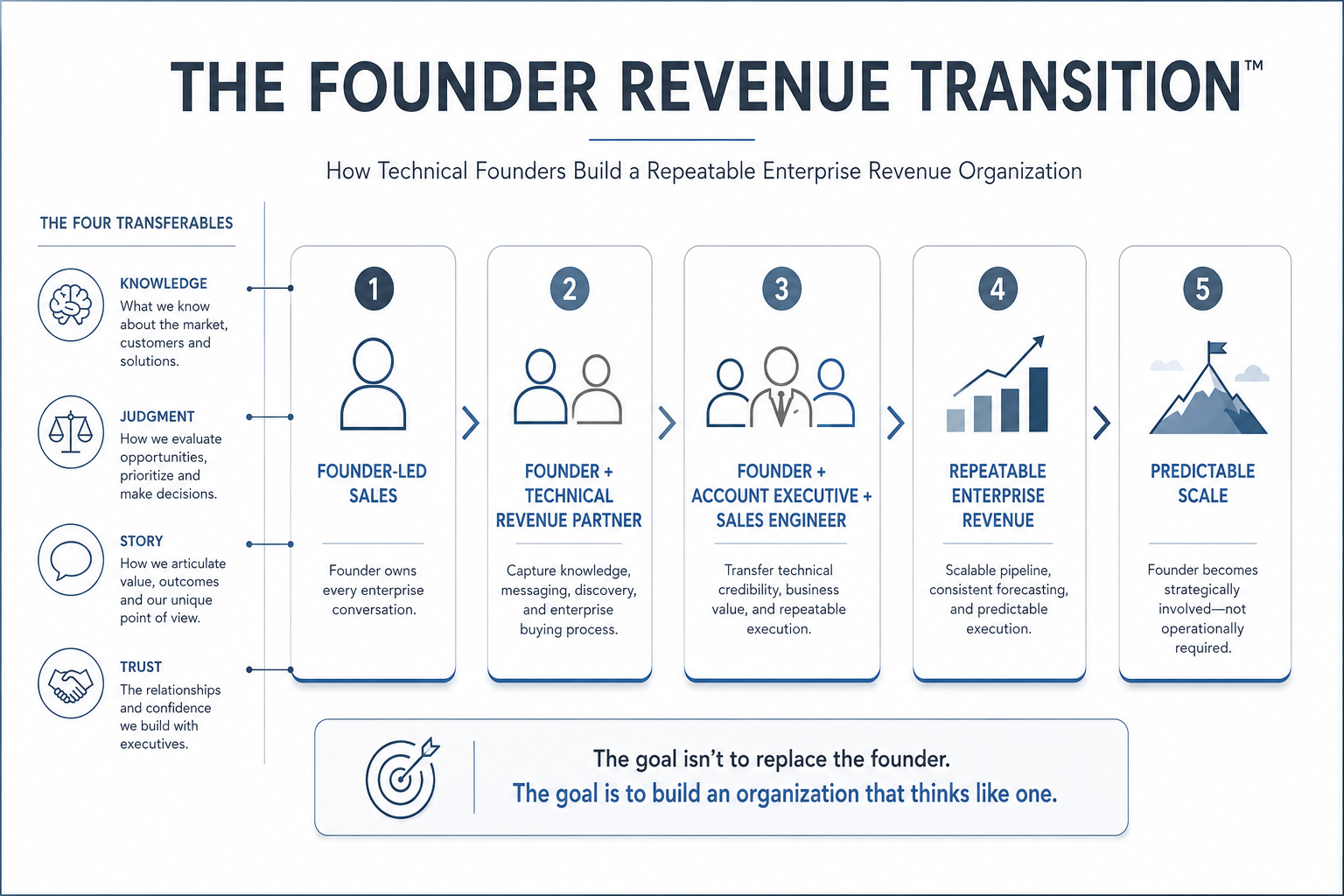
I think of that transfer in four areas:
Knowledge — What do we know about our customers, market, problems, and solutions?
Judgment — How do we evaluate opportunities, prioritize them, and make decisions?
Story — How do we explain the problem we solve, the business value we create, and why we're different?
Trust — How did the founder earn the confidence of customers and executives, and how does the company begin earning that same confidence without requiring the founder in every meeting?
Those four things have to move from the founder into the organization.
That's the Founder Revenue Transition™.
Enterprise revenue is a system, not a solo sport
Enterprise sales was never an individual sport.
A serious enterprise opportunity can involve an Account Executive, Sales Engineer, product team, security team, customer success, executives, procurement, legal — and sometimes what feels like half the company.
Early on, the founder quietly fills many of those gaps.
As the company grows, those responsibilities have to become an actual revenue system.
The AE needs more than a product demo and a territory.
They need to know which problems are worth pursuing. Who the real buyer is. What questions uncover urgency. How the company talks about business value. When technical validation is necessary. What a successful evaluation looks like. Which objections repeatedly kill deals. And when to walk away.
If none of that exists outside the founder's head, the AE isn't inheriting a sales motion.
They're being asked to invent one.
Hiring another salesperson doesn't fix that.
It usually just makes the problem more expensive.
The real transition
The objective isn't to get the founder out of customer conversations.
In fact, I think that's a mistake.
Founders should remain involved in important customers and strategic opportunities for a long time. Their presence can be an enormous competitive advantage.
The objective is different.
Stop making the founder operationally necessary.
Capture what they know.
Understand how they make decisions.
Turn the way they discover customer problems into a repeatable discovery process.
Document the objections that keep appearing.
Build technical validation around agreed business outcomes instead of generic POCs.
Teach other people how to communicate the company's value with the same confidence and clarity the founder does.
And gradually build a revenue organization capable of doing those things without needing the founder sitting in every meeting.
That's the Founder Revenue Transition™.
The goal isn't to replace the founder.
The goal is to build an organization that thinks like one.
Companies that make that transition deliberately have a chance to build predictable enterprise revenue.
Companies that skip it often remain dependent on the founder — regardless of how many salespeople they hire.
And when that happens, it's easy to blame the first AE.
But the first AE may never have been the problem.
The missing system was.
“The goal isn't to replace the founder. The goal is to build an organization that thinks like one.”